A company website explains a business. A web platform helps people do something repeatedly. That difference changes the information architecture, interaction model, technology decisions, maintenance plan, and the way success should be measured.
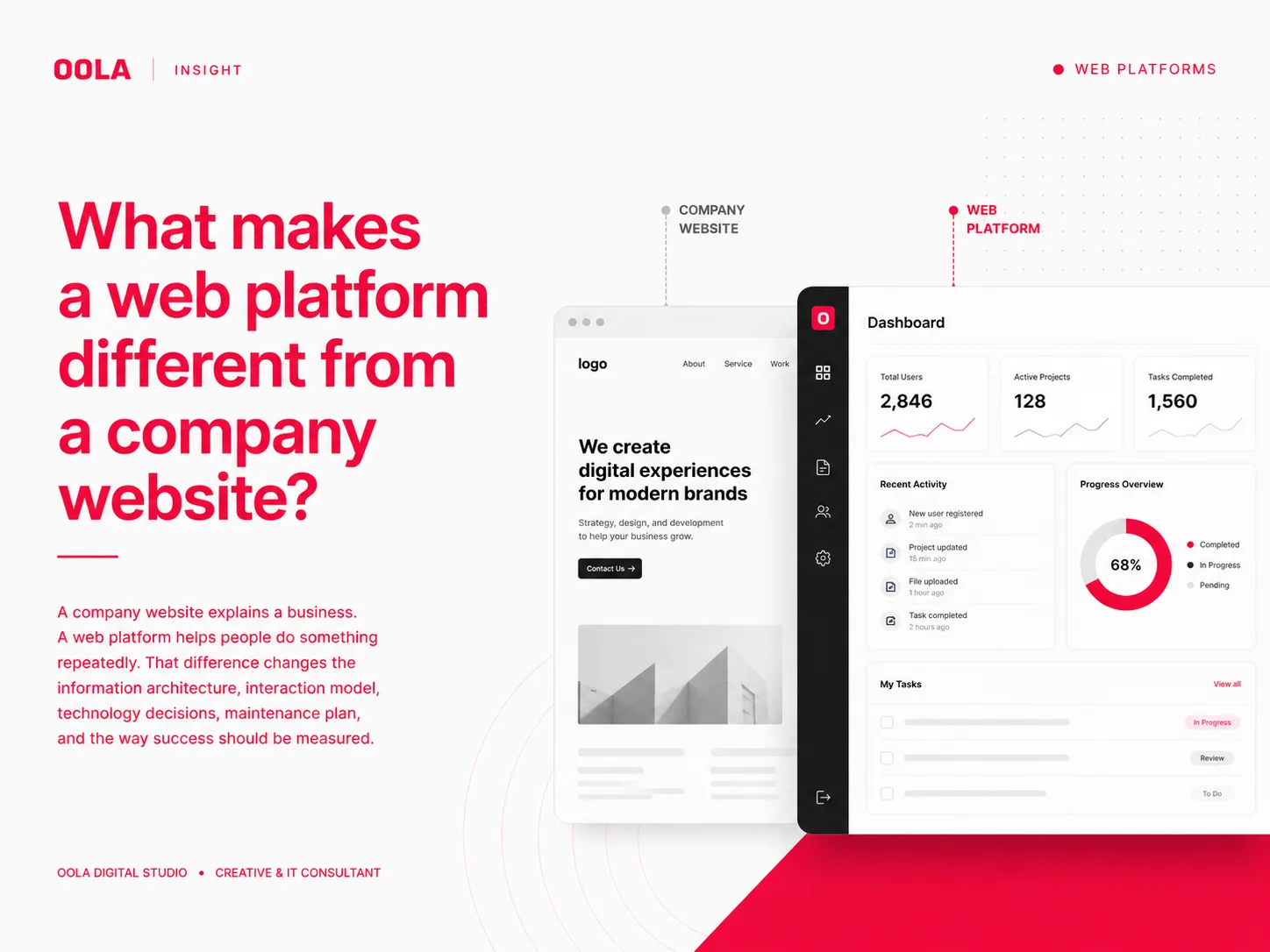
A website communicates. A platform operates.
Most company websites are built around discovery. Visitors arrive, understand the company, review credibility signals, and decide whether to make contact. The core job is communication: positioning, services, proof, and conversion.
A web platform has a different responsibility. It supports an operation, workflow, account, dashboard, portal, transaction, or repeated task. Users return because the platform contains utility, data, access, or process.
The design process starts from workflow, not pages.
For a company website, the page map is often enough to begin: home, about, service, work, contact, and supporting pages. For a platform, the first map should be a workflow map. What does the user need to start, continue, review, submit, approve, export, or recover?
This is why platform work needs stronger product thinking. Navigation, permissions, empty states, data hierarchy, notifications, and error handling are not decorative details. They are the structure of the experience.
Content is different from product data.
A website usually stores marketing content: headings, service copy, case studies, media, and legal pages. A platform stores product data: users, roles, records, statuses, files, activity, reports, and settings.
That shift affects the technical foundation. CMS decisions, authentication, database models, admin tools, integrations, and analytics should be discussed earlier when the project behaves like a platform.
The right question is not which one looks better.
The decision should come from user behavior. If the main goal is to explain the company and generate inquiries, a website can be the right investment. If users need to sign in, manage information, complete workflows, or return regularly, the project is closer to a platform.
Treating a platform like a brochure site often creates expensive rebuilds later. Treating a simple website like a platform can add unnecessary complexity. The useful middle ground is clarity about the job the surface must perform.
Key Takeaways
A website is mainly a communication surface.
A web platform is a workflow and utility surface.
Platform projects need earlier decisions about data, roles, states, and maintenance.